
{tab=Media}
PHOTOS
(Click on the image!)
VIDEO
{tab=Biography}
BIOGRAPHY
He began his singing studies at the Liszt Ferenc Music Academy of Budapest as a student of the famous Hungarian soprano, Éva Marton, who is still his master. At the moment he is a final year student in the Opera department of the Music Academy.
He debuted in the role of Desirè in a concert performance of Giordano's Fedora in 2006, at the International Opera Festival, Miskolc. (The leading roles were sung by Éva Marton and Giuseppe Giacomini, the director was Joseph Rescigno.)
In 2008 he sang the role of Ottó in Erkel's Bánk bán in the Gyula Castle Theatre, in the Csokonai Theatre of Debrecen, and on the Margaret Island Open-air Stage, Budapest (the conductor was Balázs Kocsár.) In the Csokonai Theatre of Debrecen he also sang the role of Edgardo with the famous coloratura soprano, Ingrid Kertesi.
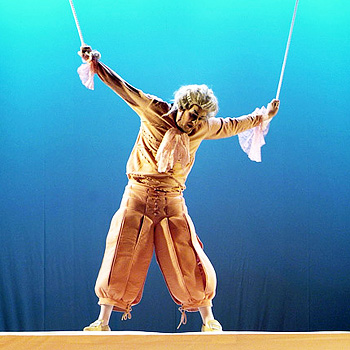
His first role at the Hungarian State Opera was Dani in György Ránki's opera King Pomádé's New Clothes, a role he has often been performing since then. He first sang Tamino in Mozart's Die Zauberflöte in a new performance of the Hungarian State Opera in January, 2010 (in László Marton's direction). He also sang this role in a concert version at the Palace of Arts, Budapest, with the National Philharmony Orchestra conducted by Zoltán Kocsis. There he also sang in Honegger's King David, Kodály's Te Deum of Budavár, Donizetti's L'elisir d'amore, Mozart's Die Entführung aus dem Serail, and in an abridged version of Puccini's La bohéme.
In November, 2006 he sang the role of Jonathan in Händel's Saul at the Music Academy of Budapest. This performance was conducted by Helmuth Rilling. In March, 2007 he sang King Midas in Bach's secular cantata „Geschwinde, ihr wirbelnden Winde" (The Contest Between Phoebus and Pan), also at the Music Academy of Budapest. The conductor was Peter Schreier.
In 2009 he created the role of Gregor Samsa in the first performance of Béla Faragó's The metamorphoses, an opera based on the work of Kafka. The opera was performed in the Sanyi and Aranka Theatre of in Budapest, the director was Andor Lukáts.
In 2009 he also sang the role of Rinuccio in Puccini's Gianni Schicchi in the Church of Kiscell (in an exam performance of the Opera department).
He sang in Kodály's Psalmus Hungaricus on divers occasions: in the Hungarian Radio in December, 2007; in Moscow, in a joint production of the Music Academy of Budapest and the Moscow Tchaikovsky Conservatory in 2008; and in the closing concert of the „Year of Kodály" in Kecskemét, Hungary.
In 2007 - in a concert on the occasion of the „Year of Hungary" - he sang in the main hall of the Music Academy of Shanghai.
In 2009 he took part in a series of concerts of excerpts from Kodály's The Transilvanian Spinning Room in Japan with the orchestra of the Musashino Music Academy (at the Tokyo Opera City Hall among others).
Awards: 2005, 2007: Kónya Sándor-scholarship; 2006: Fischer Annie-scholarship, and the scholarship of the Foundation for the Talented Young People of Debrecen; 2008/2009: scholarship of E-on Hungária PLC; 2009: Junior Prima Prize.
{tab=Interview}
(The interview was made on the 23rd of April, 2009.)
What kind of new perspectives did you get as a singer by portraying the Kafka-protagonist?
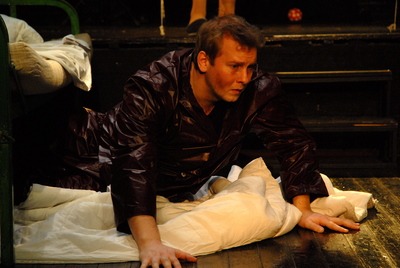
In Metamorphoses
It is quite rare that a singer, especially a tenor sings both classic and modern operas with the same good bel canto technique. In Metamorphoses you sang even the most twisted phrases in a way that it always stayed within the art of singing.
I also played in the Miskolc Symphonic Orchestra and in the National Theater of Miskolc. I was often asked why I did not sing, but I said I was waiting for the right time. I was 22 when I had my first singing lesson, but after a few lessons I left it, and rather studied as an autodidact. I think you mustn't start singing before 20, because due to the still undeveloped voice, the technique will not be built on the natural vocal material. I started my more serious singing studies here, at the Music Academy, after I was admitted to the singing-department. Thank goodness, Éva Marton became my teacher, I couldn't have found a better expert. But one year before my entrance examination I had another, decisive experience which led me to my final decision. I was still a violinist then, but was invited to sing at the Opera Ball of the Opera Friends of Miskolc. I sang Lensky's aria from Tchaikovsky's Eugene Onegin and Neapolitan songs and I felt that if I cannot do this, I will die. As a violinist I liked standing on the stage - I also played in a string quartet - but the magic of singing can be compared to nothing. I had many dilemmas whether I am suited for this calling, but fortunately I was encouraged both by my colleagues and my family. I have the necessary self-criticism, I am always trying to correct my errors. Blaming others does not lead anywhere. Thanks to Maestra Eva Marton, now I am able to see the good in all the negative things and I even wait for negative critics in a good sense. I like to know what is bad in my interpretation and how I can change it. My teacher gave me the clue that I always have to strive and step forward to the aims set and should never be despaired.
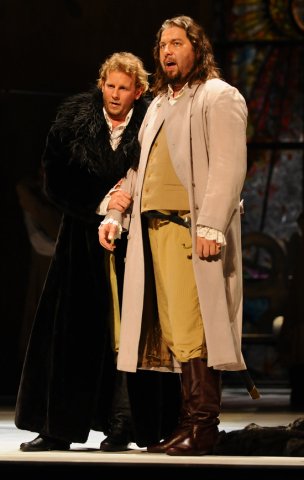
At the Hungarian State Opera I debuted as Dani in György Ránki's opera The New Clothes of King Pomádé. In the next season I will sing Tamino there in a new production of Die Zauberflöte. I sang this role in an abridged version at the Palace of Arts under the baton of Zoltán Kocsis in January, which is an unforgettable experience for me. The excellent National Philharmonic Orchestra inspired me, I enjoyed the especially good atmosphere in the rehearsals and I am pleased that Zoltán Kocsis was satisfied with us, singers. The text of this half-scenic performance was narrated by the versatile musicologist, Sándor Kovács. I have already had several performances at the Palace of Arts: Honegger's King David, Kodály's Te deum of Budavár and the abridged versions of L'elisir d'amore, Die Entführung aus dem Serail and La Bohéme with my fellow students from the Music Academy. The next challenge for me is the aria exam at the Music Academy on the 8th of May, where I will sing Max's aria from Weber's Der Freischütz, the aria of Andrea Chénier from Act 4, and the quartet from Rigoletto, under the baton of Ádám Medveczky. In September I have an invitation to Tokyo to sing highlights from Kodály's The Spinning Room, the conductor will be Kálmán Berkes. My opera debut abroad will be in 2010 in Genf, in Marten's Cinderella. I hope that our exciting artistic work with Andor Lukáts also continues: in the Sanyi and Aranka Theater I'll portray the protagonist of Stravinsky's The Tale of the Soldier in his direction.
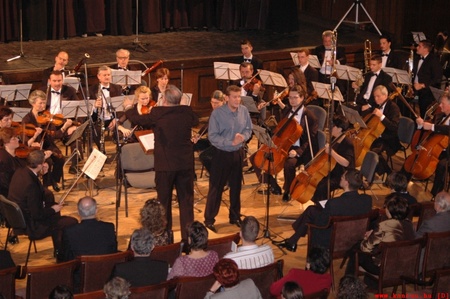
László Péterfi Nagy
{tab=News}
{tab=Repertoire}
Opera:
A. Dvořák: Rusalka - Prince
G. Donizetti: L'elisir d'amore - Nemorino
G. Donizetti: Lucia di Lammermoor - Edgardo
Péter Eötvös: Radames - 'Opera director'
F. Erkel: Bánk Bán - Ottó
Béla Faragó: Az átváltozás (The metamorphoses) - Gregor Samsa
G. Gazzaniga: Don Giovanni - Don Giovanni
W. A. Mozart: Die Entführung aus dem Serail - Belmonte
W. A. Mozart: Die Zauberflöte - Tamino
G. Puccini: Gianni Schicchi - Rinuccio
György Ránki: Pomádé király új ruhája (King Pomádé's New Clothes) - Dani
G. Verdi: Rigoletto - Duca
Oratorio and song:
J. S. Bach: Magnificat
L.v. Beethoven: Symphony No. 9
B. Britten: Seven Sonnets of Michelangelo
A. Dvořák: Requiem
G. F. Händel: Saul - Jonathan
J. Haydn: Die Jahreszeiten (The Seasons)
J. Haydn: Die Schöpfung (The Creation)
J. Haydn: Paukenmesse (Kettledrum Mass)
J. Haydn: Nelson Mass
J. Haydn: Nicolaimesse
J. Haydn: Harmoniemesse
Kodály Z.: Budavári Te Deum
Kodály Z.: Psalmus Hungaricus
G. Mahler: Das Lied von der Erde
W. A. Mozart: Requiem
G. Puccini: Messa di Gloria
G. Rossini: Stabat Mater
F. Schubert: Die schöne Müllerin
R. Schumann: Dichterliebe
G. Verdi: Requiem
{tab=Calendar}
OPERA PERFORMANCES
2010
February 7th, 14:00: Hungarian State Opera House, Ránki Gy.: The New Clothes of King Pomádé - Dani
February 17th, 19:00: Hungarian State Opera House, W. A. Mozart: Die Zauberflöte - Tamino
February 19th, 19:00: Hungarian State Opera House, W. A. Mozart: Die Zauberflöte - Tamino
March 24th, 19:00: Hungarian State Opera House, W. A. Mozart: Die Zauberflöte - Tamino
March 27th, 19:00: Hungarian State Opera House, W. A. Mozart: Die Zauberflöte - Tamino
April 9th, 19:00: Hungarian State Opera House, W. A. Mozart: Die Zauberflöte - Tamino
April 23rd, 19:00: Hungarian State Opera House, W. A. Mozart: Die Zauberflöte - Tamino
April 25th, 11:00: Hungarian State Opera House, Ránki Gy.: The New Clothes of King Pomádé - Dani
May 20th, 19:00: Hungarian State Opera House, W. A. Mozart: Die Zauberflöte - Tamino
May 22nd, 14:00: Hungarian State Opera House, Ránki Gy.: The New Clothes of King Pomádé - Dani
May 30th, 14:00: Hungarian State Opera House, Ránki Gy.: The New Clothes of King Pomádé - Dani
{tab=Reviews}
(Interview with Éva Marton, Operaportál, 2008. 12. 29.)
'In the role of Gregor Samsa Dániel Pataki Potyók holds out in every musical situation from the heroic tenor to the pottering about of the quasi-insect and the expressive recitativos. He is a great musical talent who already has a notable stage presence and it seemed that he can stand the intensive burdening, too.' (Béla Faragó: The metamorphoses; Színház, Molnár Szabolcs, August, 2009)
'The role of Rinuccio was sung by Dániel Pataki P. With his shining high notes, well constructed interpretation and - last but not least - convincing stage presence, the young tenor has convinced me that in the future he may have an important career.'
(Puccini: Gianni Schicchi; Operaportál, 2009. 06. 24.)
'Mimicry and gesture-order are the strenght of Dániel Pataki P.: in some of his slow-motion movements he did not look human at all.'
(Béla Faragó: The metamorphoses; Revizor, Tarján Tamás, 2009. 04. 20.)
'The main hero was undoubtedly Dániel Pataki P., who stepped on the stage after the arias of Medoro and Pasquale. In his two arias and in the ensembles he did not only give evidence of his vocal qualities but showed that with his strong presence he can be dominant on the stage. It would be worth putting on this forgotten opera in its entirety with him in the title role.'
(Haydn: Orlando; Operaportál, 2009. 02. 07.)
{/tabs}
